

High-Speed Door vs Rolling Shutter: Which One Is Right for Your Business?
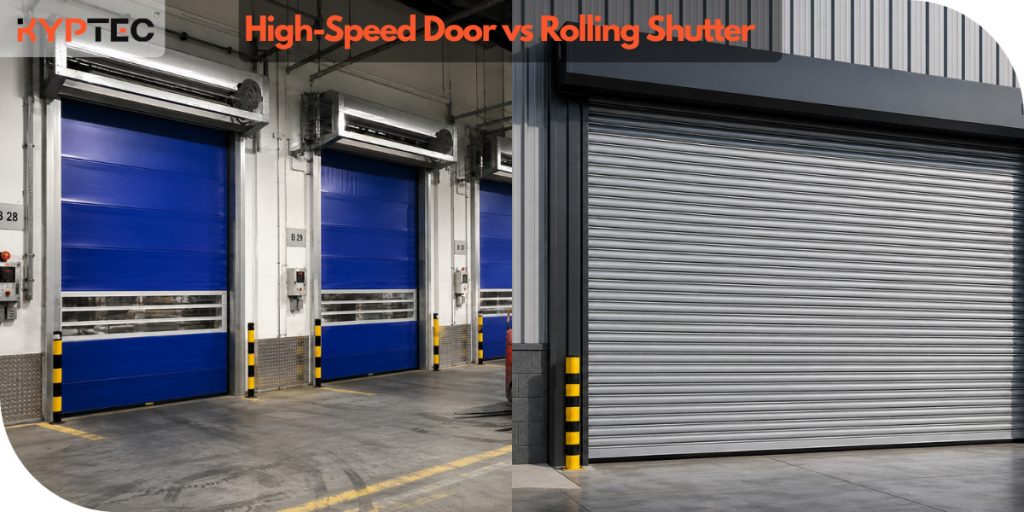
When it comes to choosing an industrial door, many businesses find themselves deciding between a high-speed door and a rolling shutter. Both options are widely used across warehouses, manufacturing facilities, logistics centers, cold storage units, and commercial buildings. However, they are designed for different purposes and offer different benefits.
The right choice depends on how your facility operates, the level of traffic you handle, your security requirements, and your long-term operational goals.
In this guide, we’ll compare high-speed doors and rolling shutters to help you determine which solution is best for your business.
Understanding High-Speed Doors
High-speed doors are automated doors designed to open and close quickly. They are commonly installed in warehouses, logistics centers, food processing plants, pharmaceutical facilities, and cold storage environments where speed and efficiency are critical.
Their main purpose is to keep operations moving smoothly while reducing energy loss and maintaining a controlled indoor environment.
Benefits of High-Speed Doors
- Fast opening and closing cycles
- Improved workflow efficiency
- Better temperature control
- Reduced dust and contaminant entry
- Enhanced workplace safety
- Suitable for high-traffic environments
Because they operate rapidly, these doors help businesses reduce delays and improve overall productivity.
Understanding Rolling Shutters
Rolling shutters are made of interlocking metal slats that roll upward into a compact housing when opened. They are commonly used in commercial buildings, warehouses, industrial units, retail shops, and storage facilities.
Their primary strength lies in providing reliable security and physical protection.
Benefits of Rolling Shutters
- Strong and durable construction
- Excellent security protection
- Cost-effective solution
- Suitable for low to moderate traffic areas
- Long service life
- Available in manual and motorized versions
Rolling shutters are often preferred when security is a higher priority than speed.
Key Differences Between High-Speed Doors and Rolling Shutters
1. Operational Speed
Rolling Shutters: Designed for occasional access and generally take longer to open and close.
High-Speed Doors: Built for frequent operation, allowing forklifts, workers, and vehicles to move through quickly without creating bottlenecks.
If your facility handles constant movement throughout the day, door speed can have a direct impact on productivity.
2. Energy Performance
Rolling Shutters: Suitable for general industrial use but may allow greater temperature fluctuations because they remain open longer during operation.
High-Speed Doors: Help maintain indoor temperatures by minimizing the amount of time the entrance remains open.
This advantage is especially important for:
- Cold storage facilities
- Food processing plants
- Pharmaceutical facilities
- Climate-controlled warehouses
When energy efficiency matters, high-speed doors typically perform better.
3. Traffic Management
Rolling Shutters: Work well in locations where access is needed only occasionally.
High-Speed Doors: Designed to handle continuous traffic without slowing down operations.
For example, in a busy warehouse where forklifts are constantly moving products, a faster door helps reduce waiting time and keeps workflows efficient.
4. Protection Against Dust and Contaminants
Dust can be a major concern in industrial environments, especially facilities located near highways, construction sites, or manufacturing zones.
Rolling Shutters: Provide protection when closed but may allow more outside air and dust to enter during operation.
High-Speed Doors: Open and close rapidly, helping reduce dust infiltration and maintain cleaner indoor conditions.
This makes them particularly useful for facilities that require a controlled environment.
5. Security and Access Control
Rolling Shutters: Offer strong physical security thanks to their robust metal construction. They are often used to protect valuable equipment, inventory, and commercial properties.
High-Speed Doors: Provide access control and operational security but are designed primarily for efficiency rather than maximum physical protection.
If your main concern is securing your premises after business hours, rolling shutters are often the preferred option.
6. Long-Term Value
Rolling Shutters: Typically involve a lower upfront investment and are a practical solution for businesses with basic access requirements.
High-Speed Doors: Require a higher initial investment but can provide long-term savings through:
- Faster operations
- Reduced energy consumption
- Improved productivity
- Better environmental control
For businesses with high daily traffic, these benefits can quickly outweigh the higher purchase cost.
Which Door Should You Choose?
The right solution depends on your business needs.
A High-Speed Door May Be the Better Choice If:
- Your facility experiences heavy daily traffic
- Operational efficiency is a priority
- Energy savings are important
- You need temperature control
- Dust reduction is a concern
- Workplace safety is a key focus
A Rolling Shutter May Be the Better Choice If:
- Security is your primary requirement
- Traffic levels are relatively low
- You need a cost-effective solution
- The door is used only a few times per day
- You prefer a simple and durable system
Final Thoughts
Choosing between a high-speed door and a rolling shutter depends on your business requirements. If your facility handles frequent traffic and needs better efficiency, energy savings, and smoother operations, a high-speed door is often the better choice.
On the other hand, if security and cost-effectiveness are your main priorities, a rolling shutter can be a practical solution.
Before making a decision, consider your daily operations, security needs, and long-term goals. Businesses looking for reliable entrance automation solutions often turn to companies like KYPTEC to find the right balance between performance, security, and value.
High-Speed Door vs Rolling Shutter: FAQs
1. What is the main difference between a high-speed door and a rolling shutter?
A high-speed door focuses on fast operation and efficiency, while a rolling shutter is primarily designed for security and protection.
2. Which door is better for warehouses?
High-speed doors are generally better for busy warehouses because they support faster traffic flow and improve operational efficiency.
3. Are high-speed doors energy efficient?
Yes, high-speed doors help reduce energy loss by opening and closing quickly, making them ideal for temperature-controlled environments.
4. Which option provides better security?
Rolling shutters typically provide stronger physical security due to their robust metal construction.
5. Are high-speed doors suitable for cold storage facilities?
Yes, high-speed doors are commonly used in cold storage facilities because they help maintain stable indoor temperatures.
6. Do rolling shutters require less maintenance?
Rolling shutters have a simpler design, but both door types require regular maintenance to ensure reliable performance.
7. How do I choose the right industrial door for my business?
Consider factors such as traffic volume, security requirements, energy efficiency goals, environmental conditions, and your budget before making a decision.